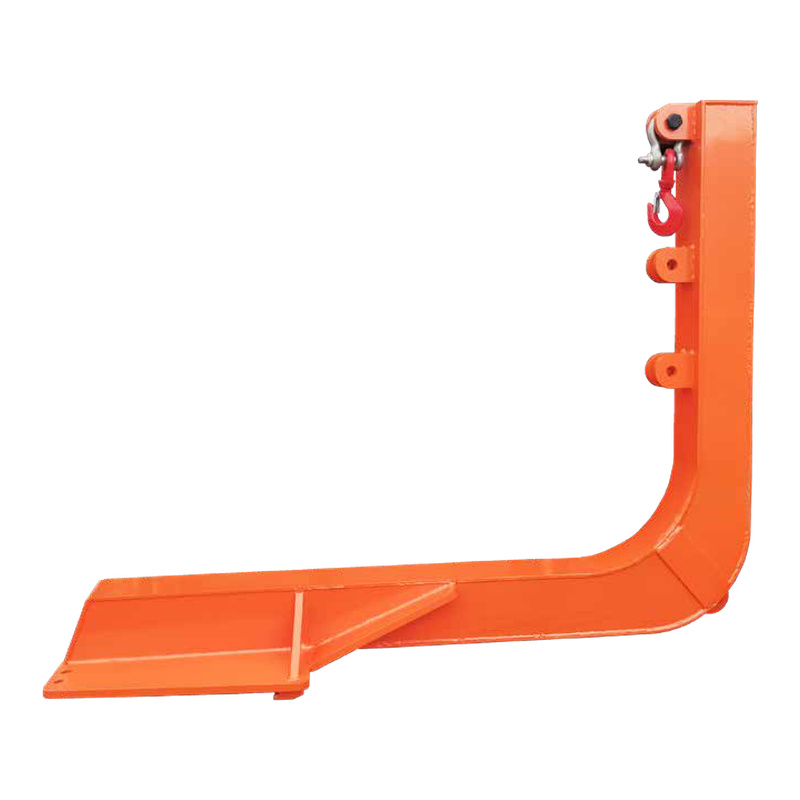
Designed for loads that cannot be supported safely by standard forks, the Forklift Jib Boom extends the forklift’s lifting range and allows controlled positioning through a dedicated hook connection. The reinforced boom structure supports machinery installation, mold replacement, equipment maintenance, and material transfer in industrial facilities. Boom length, lifting capacity, mounting position, hook configuration, and surface finish can be adjusted by an OEM/ODM Manufacturer. Compatibility can also be checked against the forklift model and load center before production. Export packaging is available for distributors, rental fleets, and project equipment buyers.

| Model | Parameter | |
| Length of boom (mm) | 1500 | Customizable |
| Height of boom (mm) | 1500 | |
| Capacity (kg) | 3000 | |
| Color | orange-red | |
1. Converts Forklift Forks Into a Lifting Arm
Forklift Jib Boom changes the forklift from bottom-support handling to overhead hook lifting. This is useful when the load has lifting eyes, sling points or an uneven base that cannot be carried well on forks. Instead of forcing irregular goods onto pallets, workers can use the boom and hook to raise the load from above and place it more accurately.
2. Reach Length Should Match Load Position
Boom reach is important because lifting farther away from the forklift mast changes the load center. A longer reach can help access machinery, racks, truck beds or work areas where forks cannot enter directly, but capacity should always be checked according to the actual lifting point. For B2B purchasing, reach length, hook position and forklift capacity should be confirmed together before order.
3. Fork Pocket Mounting for Fast Attachment
The boom is usually mounted through fork pockets, allowing the forklift forks to slide into the attachment body. A secure pocket fit helps keep the boom aligned during lifting. Buyers should check fork width, fork thickness, pocket spacing and locking method to make sure the attachment matches the forklift fleet.
4. Hook Lifting for Irregular Cargo
A Forklift Jib Boom is especially useful for cargo that needs slings, chains or lifting hooks. Motors, pumps, dies, frames, tools and bundled materials can be lifted from a central lifting point instead of being balanced on fork tips. This gives workers better control when handling goods with unusual shapes or uneven weight distribution.
5. Cost-Effective Lifting Attachment for Existing Forklifts
For warehouses that already use forklifts, a jib boom attachment can add lifting ability without buying a dedicated crane for occasional jobs. It is useful for maintenance teams, machinery workshops, dealers and factories that need flexible suspended lifting but do not require a full-time overhead crane system.
1. Machinery Installation and Repair
Forklift Jib Boom can help lift motors, pumps, gearboxes, compressors and machine parts during installation or repair. The hook lifting point makes it easier to position components that cannot be carried flat on forks.
2. Mold and Tooling Handling
Manufacturing workshops often move molds, fixtures, dies and tooling blocks with lifting eyes. A jib boom attachment gives forklifts a practical way to raise and position these heavy items near machines or storage areas.
3. Steel and Fabrication Workshops
Fabrication plants can use the boom for frames, welded assemblies, steel parts and bundled materials that are difficult to palletize. Sling lifting helps keep irregular goods more controlled during short transfers.
4. Warehouse Maintenance Work
Maintenance teams can use a Forklift Jib Boom to lift fans, motors, rollers, machine covers, spare parts or overhead components during repair work. It helps reduce manual lifting when parts must be removed or reinstalled.
5. Truck Loading of Suspended Goods
Some cargo needs to be lifted into or out of trucks with slings instead of forks. The boom can help position machinery parts, equipment frames or packed industrial goods where direct fork entry is limited.
Standard forklift forks work best when the load has a flat bottom, a pallet base or enough fork entry space. Many industrial goods do not meet that condition. A motor may have no pallet. A mold may need to be lifted from an eye bolt. A fabricated frame may be too uneven to sit securely on two forks.
Forklift Jib Boom solves this specific handling problem by moving the lifting point above the load. The forklift still provides movement and lifting power, but the goods are supported by hooks, slings or chains rather than fork contact. This makes the attachment more suitable for awkward loads, repair parts and machinery components.
The farther the hook sits from the forklift mast, the more the load center changes. This is one of the most important differences between boom lifting and pallet lifting. A forklift that can carry a certain weight on forks may not safely lift the same weight at the end of a long boom.
Before using the attachment, operators should check forklift rated capacity, boom reach, load weight and lifting point position. Buyers should also ask for a suitable boom length according to the cargo type. Shorter reach is usually better for heavier goods, while longer reach is mainly useful when access distance matters more than maximum lifting weight.
For Forklift Jib Boom supply, prepare your forklift fork size, forklift rated capacity, required boom reach, maximum load weight, lifting point type and common cargo shape. These details help check whether the boom length, pocket structure and hook arrangement match your real lifting work before quotation, sample order or batch purchasing.

 sales@neunepusi.com