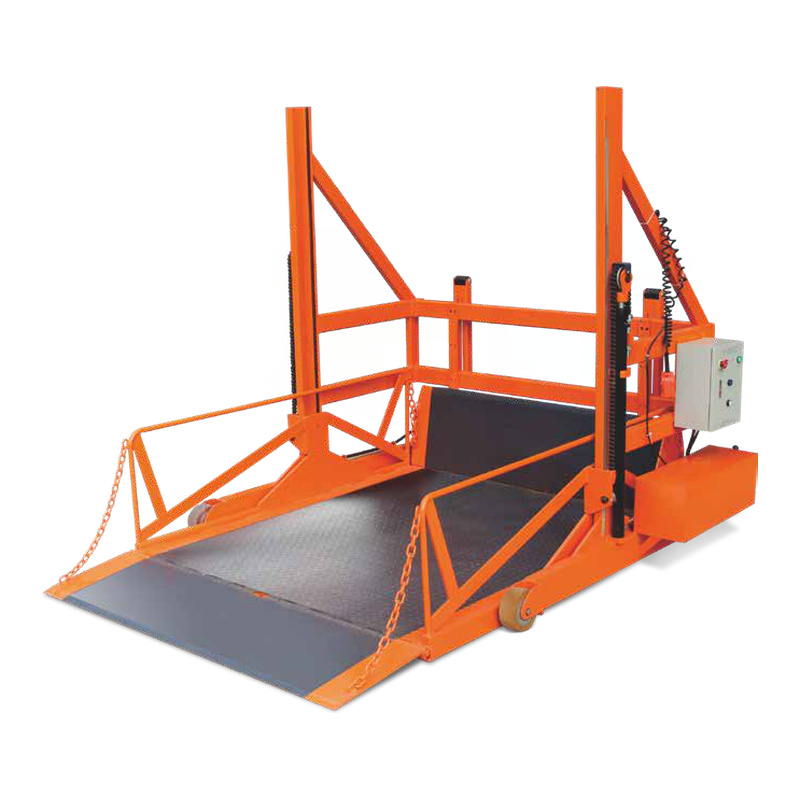
Built for loading areas with changing vehicle heights, the Hydraulic Dock Leveller raises goods and handling equipment to a maximum height of 1600 mm. Its hydraulic lifting system supports controlled vertical movement, while the wide platform accommodates pallet trucks, carts, and packaged cargo. DC24V and AC380V power options are available for different installation conditions. As an OEM/ODM Manufacturer, we can adjust platform dimensions, lifting range, capacity, controls, and safety configurations for logistics centers, production facilities, cold stores, and warehouse renovation projects.

| Model | Rated lifting capacity (kg) | Max. lifting height (mm) | Dimensions of table (mm) | Voltage (V) |
| YDQ15/16 | 1500 | 1600 | 2000x1600 | DC24V/AC380V |
1. 6T to 12T Capacity for Forklift Loading
The DCQ series covers 6000kg, 8000kg, 10000kg and 12000kg capacities, allowing buyers to match the dock leveller to forklift weight, cargo weight and daily loading frequency. Lower-capacity models are suitable for common warehouse goods, while the 10T and 12T models are better for heavier palletized cargo, industrial materials and busy loading bays.
2. 2400 × 1830mm Platform for Dock Bay Use
The 2400 × 1830mm platform size gives forklifts and handling vehicles a stable passage between the dock and the truck bed. For loading dock equipment, platform width and length are not only size details; they decide how smoothly wheels enter the vehicle and how safely goods move across the height transition.
3. 400mm Lip Board for Truck Bed Connection
The 400mm lip board rests on the truck bed during loading, creating the actual bridge between the platform and vehicle compartment. This part is important because trucks do not always stop at the exact same height or position. A proper lip board helps reduce gaps and supports smoother forklift entry into the cargo box.
4. +400mm / -300mm Height Compensation
The working distance of +400mm and -300mm helps the Hydraulic Dock Leveller handle different truck bed heights at the same bay. This matters for warehouses receiving mixed vehicles, because vans, box trucks and heavy-duty trucks may all arrive with different loading heights.
5. Pit-Mounted Structure for Fixed Loading Bays
The 2600 × 1860 × 510mm pit dimension allows the leveller to sit inside the dock area instead of taking extra floor space like a long ramp. Once installed, the dock opening stays cleaner and more organized for repeated loading work, especially in warehouses where trucks arrive throughout the day.
1. Warehouse Loading Docks
Hydraulic Dock Leveller is suitable for warehouses where forklifts move pallets directly between storage areas and truck compartments. It helps create a smoother loading path at fixed dock doors.
2. Logistics Distribution Centers
Distribution centers handling daily inbound and outbound trucks can use dock levellers to improve loading rhythm. When different vehicle heights arrive, the leveller helps reduce adjustment time at the dock.
3. Cold Chain and Food Warehouses
Cold storage, food distribution and frozen goods warehouses often need quick loading to reduce door-open time. A dock leveller helps forklifts enter trucks more smoothly during pallet transfer.
4. Manufacturing Shipping Areas
Factories can install Hydraulic Dock Leveller at dispatch doors for finished goods, raw materials, components and palletized products. It supports regular vehicle loading without relying on temporary steel plates or manual ramps.
5. Retail and Wholesale Supply Warehouses
Wholesale centers and retail supply warehouses can use dock levellers for cartons, pallet loads, store replenishment goods and mixed cargo deliveries where vehicle height changes by route.
A loading ramp creates a long inclined path from the ground to the truck. A Hydraulic Dock Leveller works differently. It sits inside the dock bay and adjusts only the small height difference between the dock floor and truck bed.
For warehouses that already have raised loading bays, a dock leveller is usually more efficient than a long ramp. It keeps the loading area compact, leaves more room for trucks, and gives forklifts a shorter transfer path into the vehicle.
The lip board is one of the most important working parts of a dock leveller. During loading, it extends from the platform and rests on the truck bed. Forklift wheels, pallet truck wheels and cargo weight all pass through this transition area.
A weak or poorly matched lip can create impact, noise and unsafe wheel movement. For frequent warehouse loading, the lip board should match the truck bed contact area, cargo weight and forklift traffic. The 400mm lip board size on the DCQ models gives the platform enough overlap for common dock loading work.
Before confirming a Hydraulic Dock Leveller order, prepare your dock height, truck bed height range, forklift weight, maximum cargo weight, pit condition, dock door width and daily loading frequency. With these details, the suitable DCQ capacity, motor configuration and pit layout can be checked before quotation, helping the loading bay fit real warehouse traffic instead of relying only on standard model selection.

 sales@neunepusi.com